
Why Your Roof Only Leaks in January and February: The Science of Maine Freeze-Thaw Infiltration
Your roof survived torrential July downpours without a single drop entering your home. But come mid-January, water suddenly begins staining your living room ceiling. Here is the exact physics behind Maine’s notorious winter-only leaks—and how to diagnose whether it’s an ice dam, flashing contraction, or attic frost.
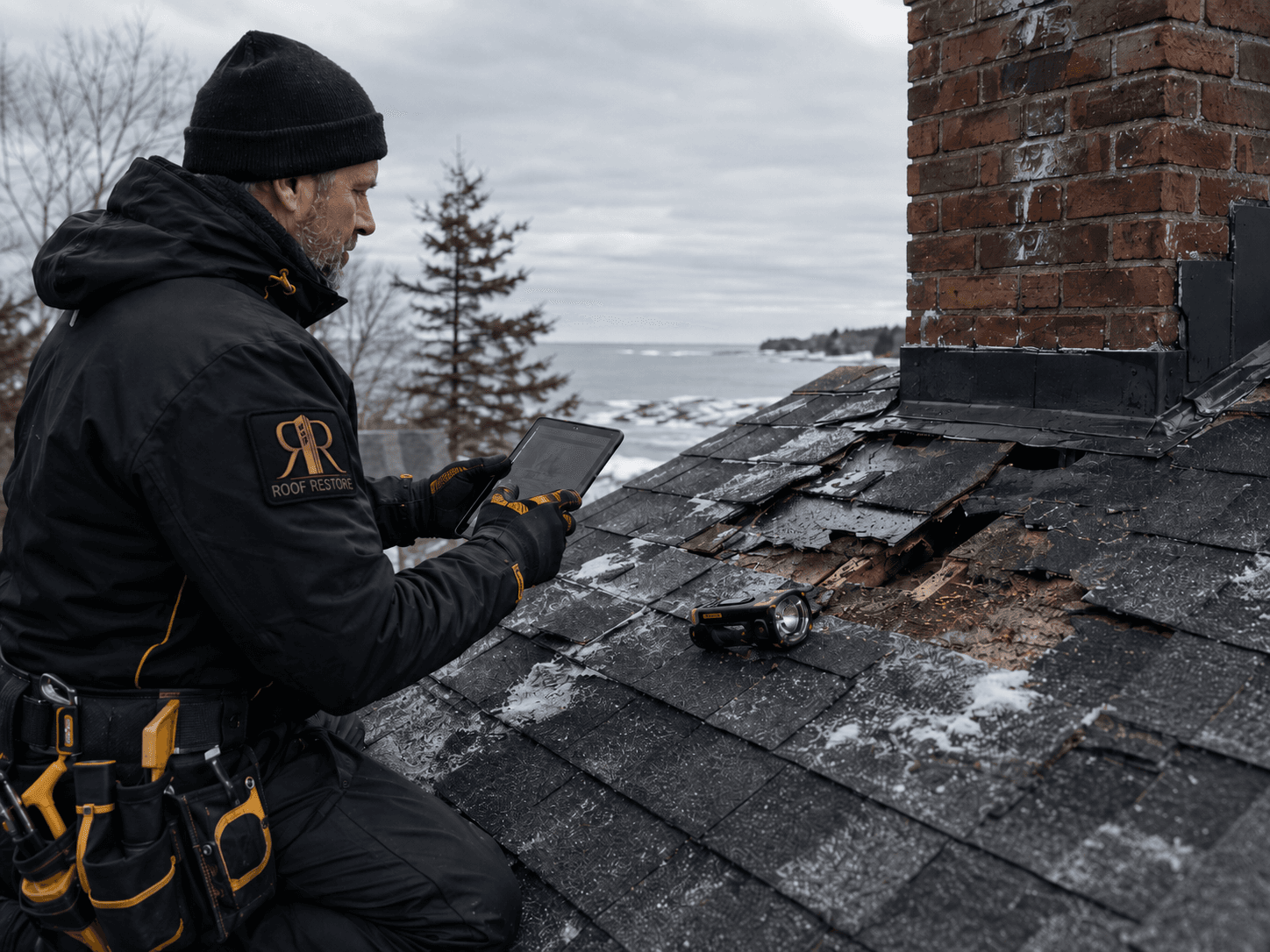
Thermal scanning and gentle steam channel creation during a sub-zero January freeze-thaw emergency in Southern Maine.
The 3-Second Winter Leak Diagnostic
Match your symptoms to pinpoint the exact failure point
Leaking Near Outer Exterior Walls
Almost certainly an Ice Dam. Water is trapped behind frozen gutters and climbing upward under the eaves.
Leaking Around Chimney or Vent Pipe
Differential Thermal Contraction. Cold snap contracted metal flashings away from masonry or dried sealant joints.
Dripping in Middle of Room on Sunny Days
Attic Frost Condensation. Indoor warm moisture accumulated as frost on roof decking and is raining down as the sun heats the attic.
1. The Diurnal Cycle: How Gravity-Based Shingles Fail Against Water
Asphalt architectural shingles and cedar shakes are not waterproof membranes; they are water-shedding systems. They rely entirely on gravity to shed liquid downward before it can seep between overlapping courses.
In Maine’s mid-winter climate, this gravity-first defense is shattered by the diurnal freeze-thaw rhythm:
- 1. Daytime Solar & Heat Loss Melt: Even in 25°F air, solar radiation heating dark shingles and attic heat loss warm the underside of the snow blanket, creating a constant trickle of water down the roof deck.
- 2. The Eave Dam Barrier: When that trickle reaches the overhang (which has no heated living space below it), temperature drops below 32°F instantly, freezing into an ice ridge.
- 3. Hydrostatic Capillary Back-Up: As the ice ridge grows into a dam, meltwater forms a pond. Standing water generates hydrostatic pressure, driving water upward beneath shingle laps by capillary action. Once past the nail line, water soaks the wood deck and enters your ceiling.
2. The Thermal Shock: Metal Flashings vs. Masonry & Wood
Few homeowners realize that buildings physically shrink during Maine’s extreme -10°F cold snaps. The problem is that different construction materials shrink at vastly different rates:
The Physics of Winter Joint Failure
Aluminum and steel flashings have a thermal coefficient of expansion 3 to 5 times higher than red clay brick or structural lumber. When ambient temperatures plummet 40 degrees in 12 hours:
- Chimney step flashings: The metal contracts and pulls slightly away from the mortar reglet joint, cracking brittle silicone or urethane caulking applied during summer.
- Plumbing vent boots: Neoprene rubber collars stiffen into brittle plastic under freezing cold, cracking along the pipe seal and allowing melting snow to trace the pipe straight to your bathroom ceiling.
3. The "Ghost Leak": Attic Frost Condensation
Roughly 25% of the emergency winter leak calls we receive in Cumberland and Androscoggin County are not roof penetrations at all—they are attic ventilation and air sealing failures.
How It Builds in Silence
Warm, moisture-laden air from showers, cooking, and human respiration escapes into the attic through unsealed can lights, attic hatches, and bath fans. In sub-zero weather, this water vapor instantly freezes to the cold plywood roof sheathing, building up a blanket of white frost up to an inch thick.
The January Thaw Meltdown
On the first 40°F sunny afternoon in late January or February, that entire frost layer melts within 90 minutes. Gallons of water saturate attic insulation and pour through drywall seams across multiple rooms simultaneously.
4. Dangerous DIY Myths That Destroy Maine Roofs
Avoid These Common Winter Mistakes:
- No Axes, Shovels, or Pickaxes: At 15°F, asphalt shingles are like glass. Striking the ice with metal tools punctures the waterproof underlayment and snaps shingle corners, causing permanent leaks that won’t stop until full summer replacement.
- No Rock Salt in Pantyhose: Rock salt (sodium chloride) chemically degrades asphalt shingle binders, corrodes aluminum gutters, and kills delicate landscaping and shrubbery below when saline meltwater drains off.
- No Open Flame Blowtorches: Multiple New England structures suffer total fire loss every winter from homeowners attempting to melt frozen gutters with propane torches.
5. The Safe Professional Fix: Thermal Imaging & Low-Pressure Steam
When a freeze-thaw leak strikes, professional contractors utilize two non-invasive technologies:
1. FLIR Thermal Infrared Moisture Mapping
Pinpoints the exact path of wet insulation and moisture migration behind ceilings without tearing open drywall needlessly.
2. Low-Pressure Hot Water Steaming
Uses 290°F steam at gentle low pressure (under 300 PSI) to slice through 18 inches of solid ice in minutes without abrading a single shingle granule.
Active Winter Leak or Dam in Southern or Central Maine?
Don’t let January freeze-thaw cycles ruin your ceilings, insulation, and hardwood flooring. Our certified crews provide rapid thermal moisture inspection and non-destructive steam relief.
Frequently Asked Questions
Why does my Maine roof leak during winter snow but never during heavy summer thunderstorms?
Summer thunderstorms shed rapidly off the roof by gravity along downward-sloping shingles. In January and February, ice dams at the cold gutters trap meltwater, creating standing ponds. Because shingles are not watertight against standing water, hydrostatic pressure and capillary action force water backward and upward under the shingle laps, bypassing standard underlayment.
Can attic frost masquerade as a roof leak in winter?
Yes. Warm, moist air escaping from living spaces into the attic condenses on sub-zero roof decking and turns into solid white frost. When outdoor temperatures briefly rise above freezing on a sunny January afternoon, that frost melts simultaneously across hundreds of square feet, dripping through ceiling drywall and exactly mimicking a massive active roof puncture.
Why do chimney and valley flashings leak more in sub-zero Maine temperatures?
Different materials contract at different rates when temperatures plunge from 35°F to -10°F. Aluminum and copper flashings shrink faster than brick masonry or timber roof trusses. This differential thermal movement tears brittle caulking and pulls counter-flashings away from mortar joints, creating micro-gaps for driven snowmelt to penetrate.
Is it safe to break ice dams with a hammer or pickaxe?
Never. Shingles become extremely brittle at sub-freezing temperatures. Striking ice dams with a hammer, axe, or shovel shatters shingle tabs, punctures underlayment, and voids manufacturer warranties. Only calibrated low-pressure hot water steamers should be used to cut drainage channels through ice dams.